
Monthly Meal Planner Workbook is turns a month of dinners into one inventory, one plan, one big shop, and a short weekly perishables list, so you buy less, waste less, and stop deciding what's for dinner every single afternoon.
Full disclosure: I wrote the Monthly Meal Planner Workbook and created the companion course, and I earn money when you buy either one. This is a walkthrough of what's inside and what it costs, so you can decide whether it fits your kitchen.
Most of us plan dinner one week at a time, or not at all. Then we're standing in front of the refrigerator when we're hungry, or wandering the supermarket picking up things we don't need because the display makes them look like something we have to try. Meanwhile, something in the back of the fridge is quietly turning into a science experiment. The Monthly Meal Planning Workbook is my answer to that: plan once, shop smarter, and eat well all month. It works whether you're on a fixed income, a part-time income, a lot of money, or very little, because the rent, the car payment, and the insurance all come due monthly no matter how your paycheck lands.
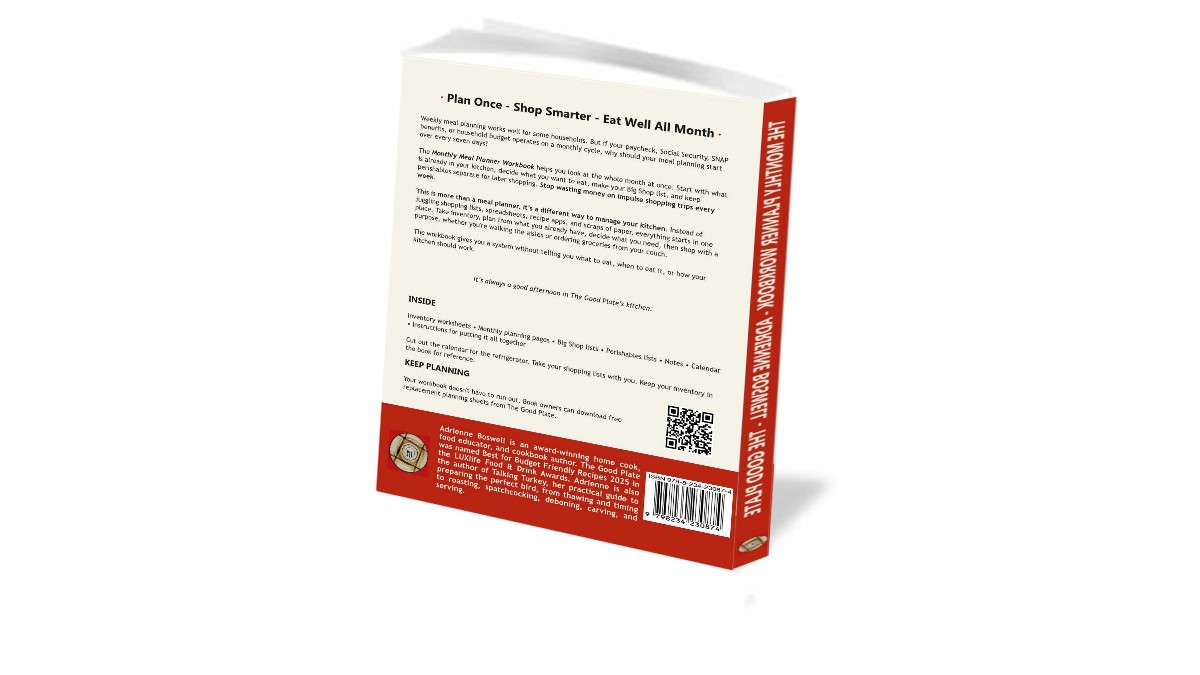
Monthly Meal Planner Workbook
A 12-month, undated planning workbook built around four steps you repeat every month: take inventory, plan your dinners around what you have, do one big shop for shelf-stable and freezable foods, and keep a short perishables list for weekly pickups. It's not a diet plan, so it works with any way of eating.
Monthly Meal Planner PROS and CONS
Pros
- Works for any income and any pay schedule, because it matches food spending to the monthly cycle your other bills already follow
- Simple four-part system you repeat every month
- Cuts impulse purchases and extra grocery trips
- Regular inventory means less forgotten food going to waste
- Not a diet plan, so it works with any way of eating
- 12 undated monthly sections and tear-out pages you can take to the store
- A companion course is available if you want more guidance
Cons
- The first inventory takes real time, especially if your freezer and pantry are crowded
- A once-a-month big shop needs some freezer and pantry space
- Perishables still mean short weekly trips
- It's a planning system, not a cookbook, so you bring the meal ideas
- The fillable PDF is a separate purchase from the paperback
Monthly Meal Planner Workbook In-Depth Review
How the System Works
The workbook is built in four parts, and you repeat them every month.
- Inventory. Go through your refrigerator, freezer, and pantry and write down what you have and what you don't. This is also when you find and toss the science experiments.
- Meal planning. Build your month around that inventory. Got ground beef? That's burgers. Got a chicken? That's Saturday dinner. Planning 30 days sounds like a lot of work, but it's much easier than planning every week or having no plan at all.
- The big shop. Anything your plan needs that you don't have goes on the big shopping list: shelf-stable items and things you can freeze, bought once a month.
- The perishables list. Lettuce, tomatoes, bread, milk, and anything else that would spoil if it sat from the first of the month to the end. These are your quick weekly pickups.
My Weekly Dinner Rhythm
In my house, the plan follows the same weekly rhythm all month, and I just change the dishes. Saturday is the big meal, with leftovers on Tuesday. Sunday is a light dinner, often Asian, so there aren't many pots to wash before work on Monday. Monday is burger night, using burgers I've seasoned and frozen ahead, with fries in the air fryer. Wednesday is my experiment day; Thursday is leftovers, dinner out, or breakfast for dinner; and Friday is fish or a meat-free meal. Your rhythm will look different, and the workbook is designed for that.
What's Inside the Book
The workbook includes 12 undated monthly planning sections, so you can start any time of year, plus tear-out calendar and shopping pages you can take to the store. There are no calorie counts and no "good" or "bad" foods. It handles the logistics: inventory, timing, shopping, and budgeting. What you eat is up to you.
What It Costs and What It Can Save
When I switched from chasing sales with no plan to running the month as one shop, I saved about $50 a month, almost immediately. Your number will depend on your household and how much impulse buying and food waste you're cutting, but here's how the costs stack up against that.
- The paperback workbook lists at $26.99 and is currently 30% off at the IngramSpark shop.
- The course, How to Plan Meals: Do It Once a Month to Save Time and Money, is $22.99 for early students (regularly $60). It has 3 sections and 17 lessons, takes a little over two hours including filling out your own inventory sheet, calendar, and shopping lists, and includes course activity sheets, a coupon for free reprints of your planner pages, and a discount on the fillable PDF workbook.
Even taking both, the total is less than what monthly planning saved me in my first month. The book on its own pays for itself the first time you skip one unplanned takeout night or stop throwing out a bag of wilted greens.
Who Should (and Shouldn't) Buy This
If you're tired of deciding what's for dinner every afternoon, tired of grocery bills that don't add up by the end of the month, or tired of throwing food away, this workbook gives you a way to do the thinking once and be done for four weeks. If you're looking for a recipe book or a diet plan, this isn't it; it's the system that makes whatever you cook easier to plan and shop for.
Thank you for reading. If you're ready to plan once and shop smarter, the Monthly Meal Planning Workbook is currently 30% off, and if you'd like me to walk you through it step by step, the course is there too!
Monthly Meal Planner Video Transcript
Review
Good afternoon and welcome to the Good Plate's Kitchen.
Today I want to talk to you about a book that I wrote called the Monthly Meal Planner Workbook.
It tells you how to plan once, shop smarter, and eat well all month.
Now, why would you want to plan your meals monthly?
You want to plan your meals monthly if you are tired of going to the store and impulse shopping,
and buying things that you don't need just because the supermarket makes it look like you have to try this.
You don't.
This also works very well if you are on a fixed income. It works well if you are on a part-time income.
It works well if you have a ton of money.
It works well if you don't have very much money at all.
It just works well.
And the great thing about it is you save money doing this because you're not buying things you don't need.
And because you're going to be taking an inventory, you know what things are and where things are, so you're not going to have a lot of science experiments in the back of the refrigerator.
So, let's talk about the book.
Again, it is the Monthly Meal Planner Workbook.
Plan once, shop smarter, eat well all month.
Now, we're going to talk about the parts of the book. In the beginning, it tells you exactly how to use the system.
And it's basically in four parts.
Inventory is part one.
The meal planning is part two.
Big shop is part three.
And a perishables list is part four.
Very simple.
So, inventorying you do every month.
You go in and you take inventory of what you have and what you don't have.
While you're taking inventory, you can also find out what's in the back of your refrigerator that is turning into a science experiment and get rid of it.
Number two, part two, is you start actually planning out your meals.
I know this sounds like it probably takes a long time and it's very difficult.
It's not.
It is much easier to plan for 30 days than it is to plan every week or have no plan at all.
Because no plan at all means you're standing in front of your refrigerator going, "Ah?" when you're hungry, and you wind up eating the wrong thing.
No.
So, since you have the inventory, let's say you have chicken, you know, some ground beef.
Maybe you have a pork roast.
And maybe some fish.
Now, my meal plan, you can see I have one on the refrigerator over here.
My meal plan is very simple, and it's the same just about every week.
I change the dishes around, but it's about the same.
Saturday is the big meal, because Sunday is a light meal.
Saturday is the big meal that I have leftovers from for Tuesday.
And I do it on Saturday instead of Sunday because I have to go to work on Monday.
That's the reason why Sunday's meal in our house is usually Asian or some other light dinner,
so there aren't a lot of dishes and pots and pans to wash, because you have to go to work on Monday.
Speaking of which, Monday is our burger night.
And I have burgers that I have seasoned and frozen.
And it's just a matter of taking a burger out of the freezer and some fries, sticking them in the air fryer, and done.
Tuesday, it's those leftovers from Saturday.
Wednesday is my experiment day.
You can do whatever you want to do with your Wednesday.
Thursday is usually leftovers from Wednesday.
Or it might be the day that we have dinner out.
Or it might even just be breakfast for dinner.
And Friday is usually our day that we have fish or a meat-free meal.
And I like to have fish, not for religious reasons or anything like that.
It's just an easy day to remember, and it's kind of nice to have fish on Friday.
Okay, so now that you have a plan, you look at whatever your inventory is. "Oh, I have ground beef, I can make burgers."
"Oh, I have a chicken. I can make a chicken on Saturday."
Very easy. Very good.
Okay, then we're going to say, "Okay, I have that chicken for Saturday. What do I want to have with the chicken? How about maybe some mashed potatoes? Do I have any mashed potatoes? No, I don't."
So that's going to go on to a shopping list.
We have two shopping lists.
We have one called the big shopping list. It's the one you use once a month.
It's for things that are shelf-stable or things that you can freeze.
We have another shopping list called the perishable shopping list.
And that is for things that are going to become science experiments if they're sitting in your fridge from the beginning of the month to the end of the month without being eaten.
So lettuce, tomatoes, bread, milk, things like that that we get on a regular basis, more on a weekly basis.
So that's it. That's all you have to do.
And the book is available on Amazon and coming to a store near you soon.
We also have a full course that you can take that explains this even more.
So we hope to see you in the bookshelf soon.
Thank you for watching.
Remember, forever forward, forever flavorful. Yum, yum!
